The DNA of Your Kitchen: Understanding Fatty Acid Profiles
Whether you are a professional chef or a home cook, you’ve likely seen terms like “monounsaturated” or “high oleic” on a bottle of oil. But what do these actually mean for your cooking?
The answer lies in the Fatty Acid Profile. Think of this profile as the “DNA” of an oil. It tells you exactly how that oil will behave when it hits a hot pan, how long it will stay fresh in your pantry, and how it affects your health.
In this guide, we’ll use High Oleic Sunflower Oil—specifically the industry-leading profile from Colorado Mills—to explain why these chemical building blocks are the most important thing to look for in any cooking oil.
Curious about the science behind our process? Learn more About Colorado Mills and our commitment to solvent-free, high-quality oil production.
1. What is a Fatty Acid Profile? (MUFA vs. PUFA)
At a microscopic level, all cooking oils are made of different “families” of fats. A Fatty Acid Profile is simply a map of how much of each family is inside the bottle.
- Monounsaturated Fats (MUFA): These are the “stable” fats. They have a strong molecular structure that resists heat and oxygen. The star of this family is Oleic Acid.
- Polyunsaturated Fats (PUFA): These are “fragile” fats. They have multiple “weak points” (double bonds) that break down quickly under heat, leading to smoke and off-flavors.
- Saturated Fats: These are very stable but are often solid at room temperature.
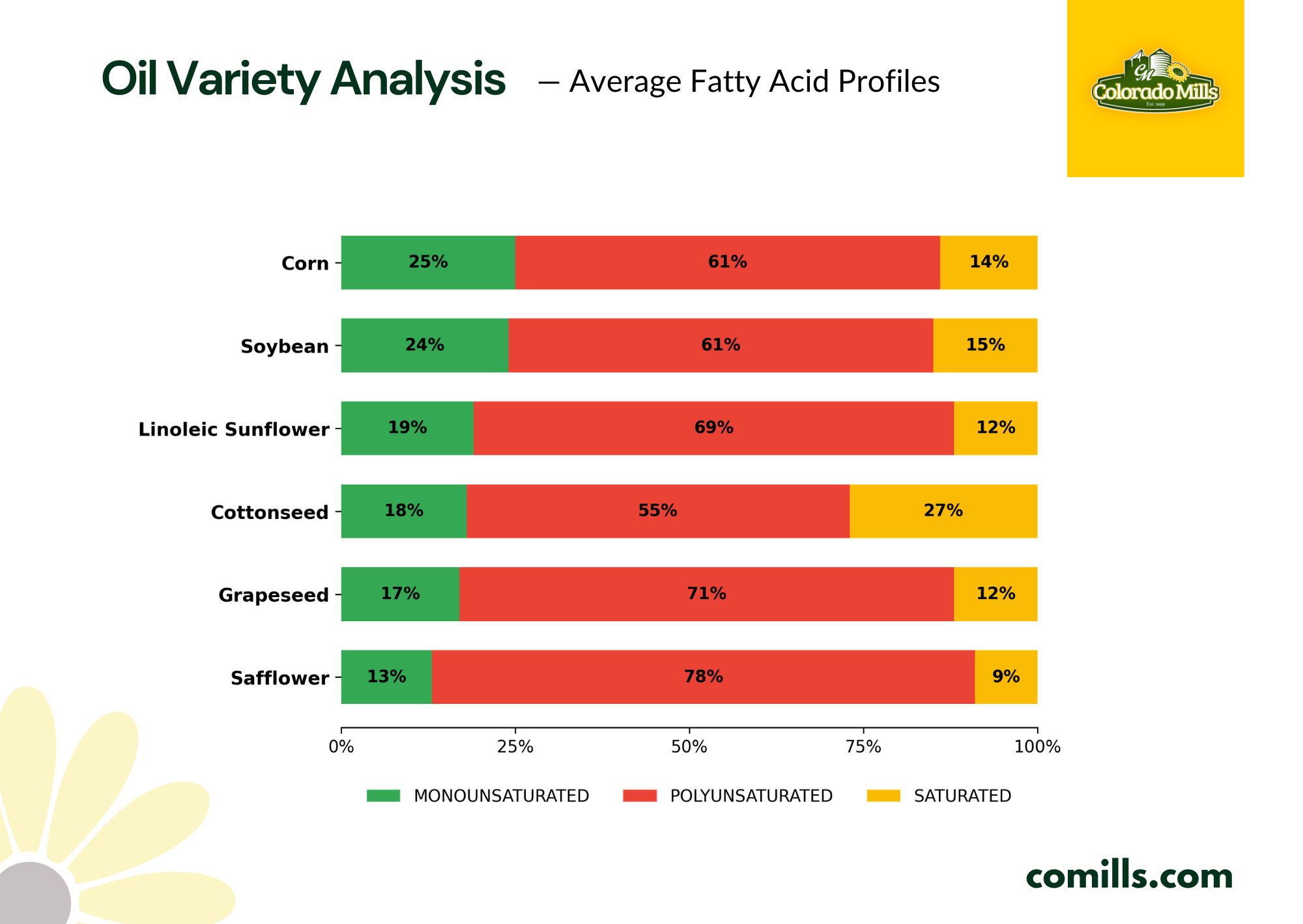
Guide: This chart is your “Map of the Oil World.” It shows how different oils stack up. Notice how High Oleic profiles sit in a completely different stability zone.
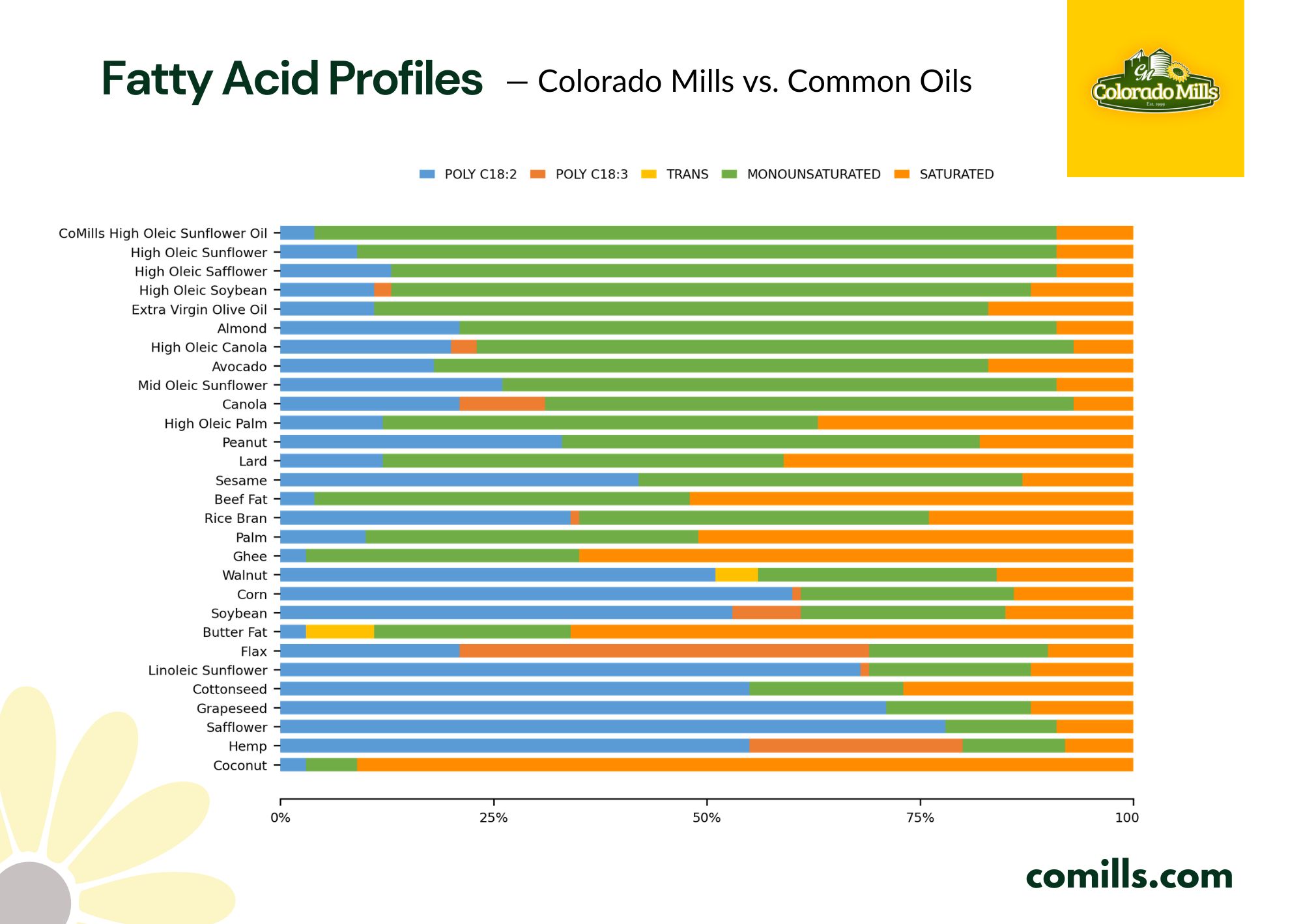
The Golden Ratio: For high-heat cooking, you want a profile that is High in MUFA and Low in PUFA.
Not sure what to look for on the label? Check out our Sunflower Oil Information to understand the health benefits of a high-oleic profile.
2. The High Oleic Sunflower Oil Profile: A Quality Hierarchy
Not all sunflower oils have the same DNA. Through natural breeding, we can change the Fatty Acid Profile to make the oil more stable. This is where the term “High Oleic” comes from.
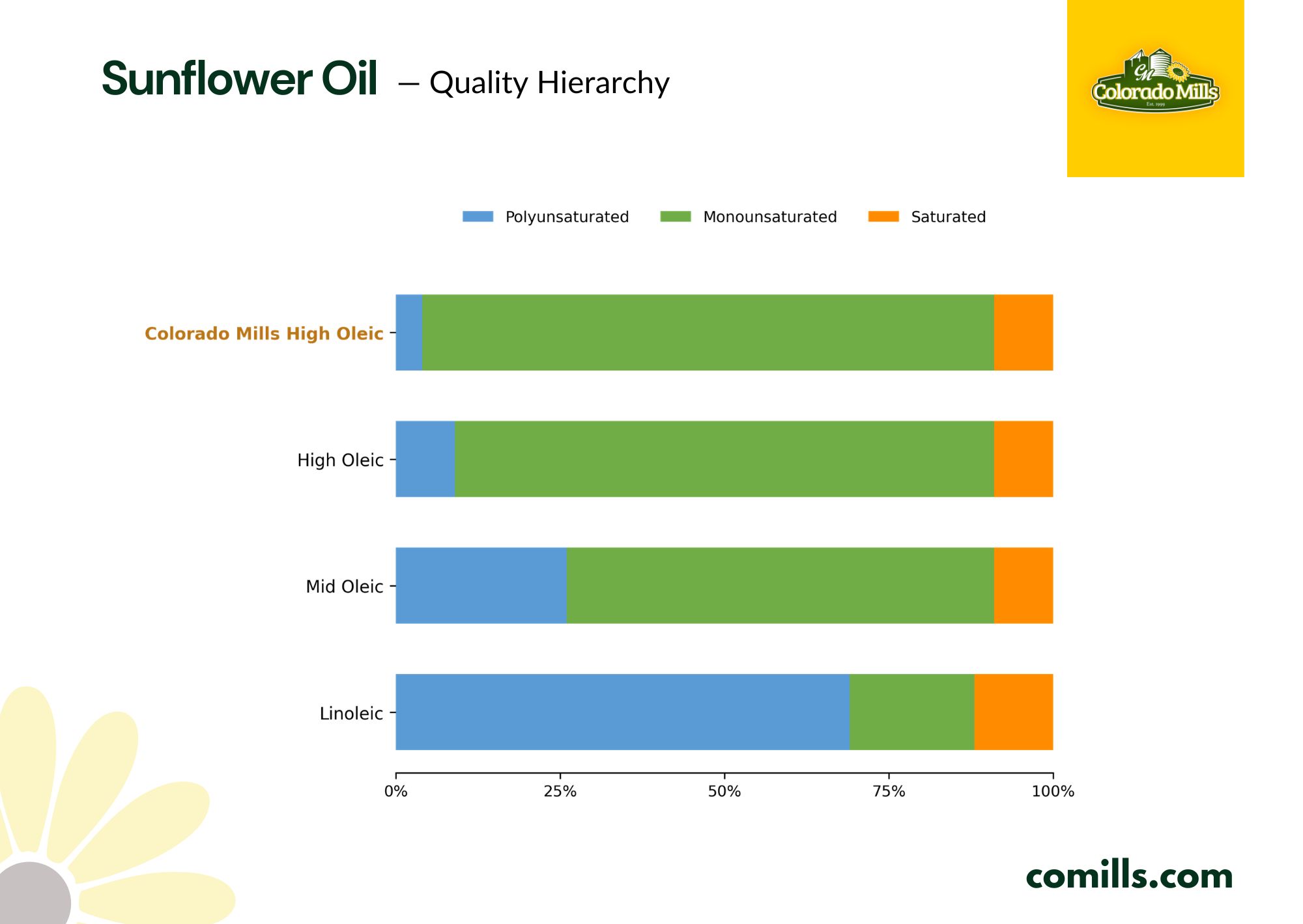
- Linoleic Profile: High in “fragile” PUFA (~69%). This is standard oil that breaks down quickly.
- High Oleic Profile: Swaps the fragile fats for stable ones, typically reaching 82% MUFA.
- Colorado Mills Profile: The peak of the hierarchy. It reaches 87% Monounsaturated fat, with an ultra-low 4% Polyunsaturated profile.
Guide: This visual shows the “evolution” of a profile. As the green bar (stable fat) grows, the oil becomes a professional-grade tool
3. Why a “Fragile” Profile Ruins Your Food
When an oil’s profile is too high in Polyunsaturated fats (PUFA), it is prone to Oxidation. This is a chemical reaction where heat and oxygen “attack” the fragile fats.
If you are using an oil with a poor fatty acid profile, you will notice:
- Rapid Darkening: The oil breaks down and turns black prematurely.
- Off-Flavors: Your food starts to taste “fishy” or “painty” because the fragile fats are literally rotting under the heat.
- Sticky Residue: That gummy buildup on your equipment is caused by unstable fats “polymerizing” (turning into a plastic-like coating).
Guide: Look at the high red bars in oils like Corn or Soybean. That red represents the “fragile” PUFA that causes these kitchen problems.
Want to see this stability in action? Browse our Recipes for high-heat cooking inspiration using high oleic oil.
4. Comparing Profiles: High Oleic vs. Avocado & Animal Fats
Many people assume Avocado oil or Beef Tallow are the only stable options. However, when you look at the Fatty Acid Profile, a high-purity High Oleic Sunflower oil often has the edge.
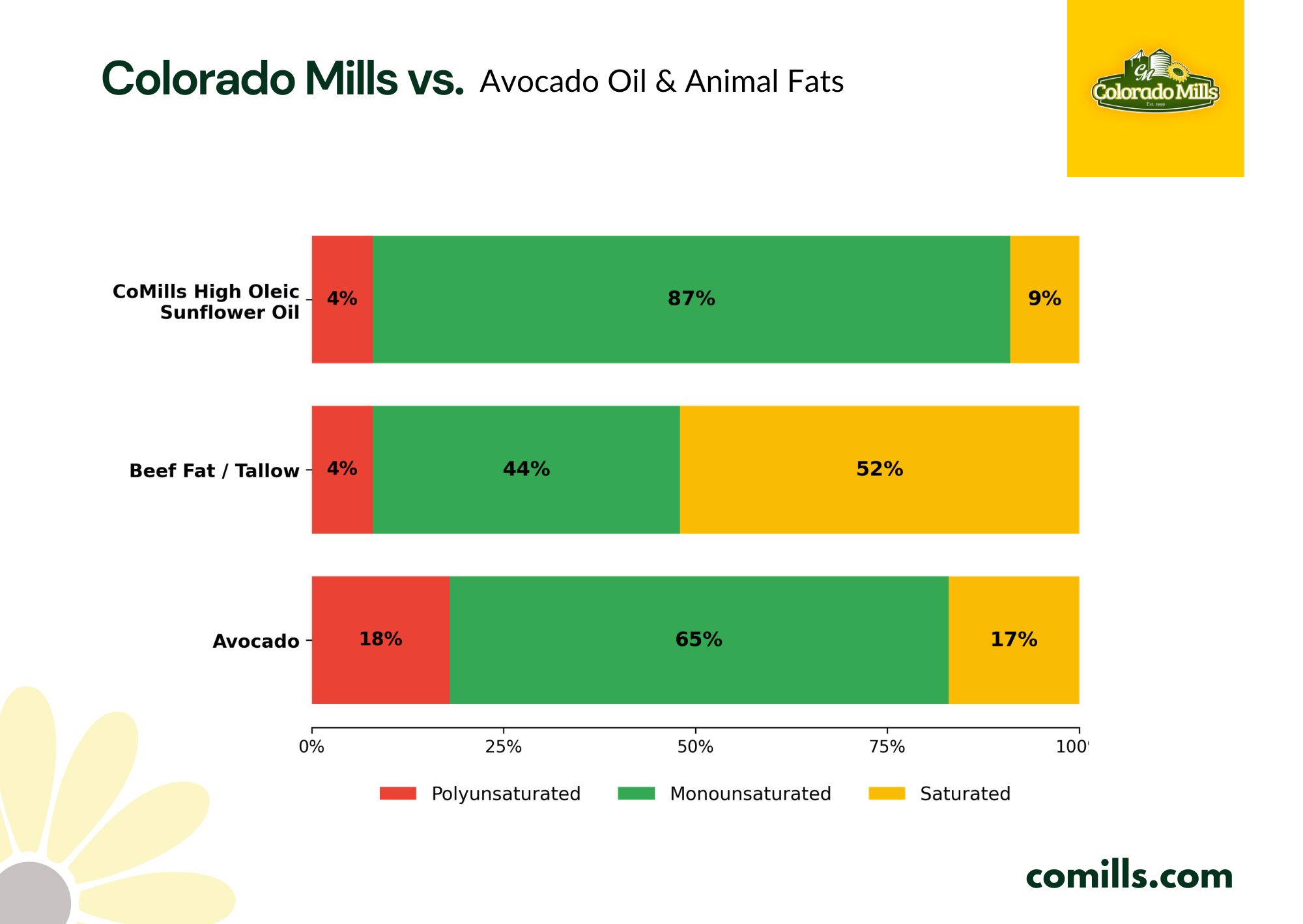
- Avocado Oil Profile: While high in stable fats, it typically carries 4x more fragile PUFA (~18%) than the Colorado Mills profile (~4%).
- Animal Fat Profile: Stable due to saturated fats, but lacks the neutral flavor and heart-healthy profile of a high-oleic vegetable oil.
Guide: This direct comparison shows that even against “premium” fats, the Colorado Mills profile is more optimized for stability.
Ready to upgrade your kitchen? Shop our Consumer Bottles and experience the difference of 100% natural, high-oleic oil.
5. From Profile to Performance: The OSI Proof
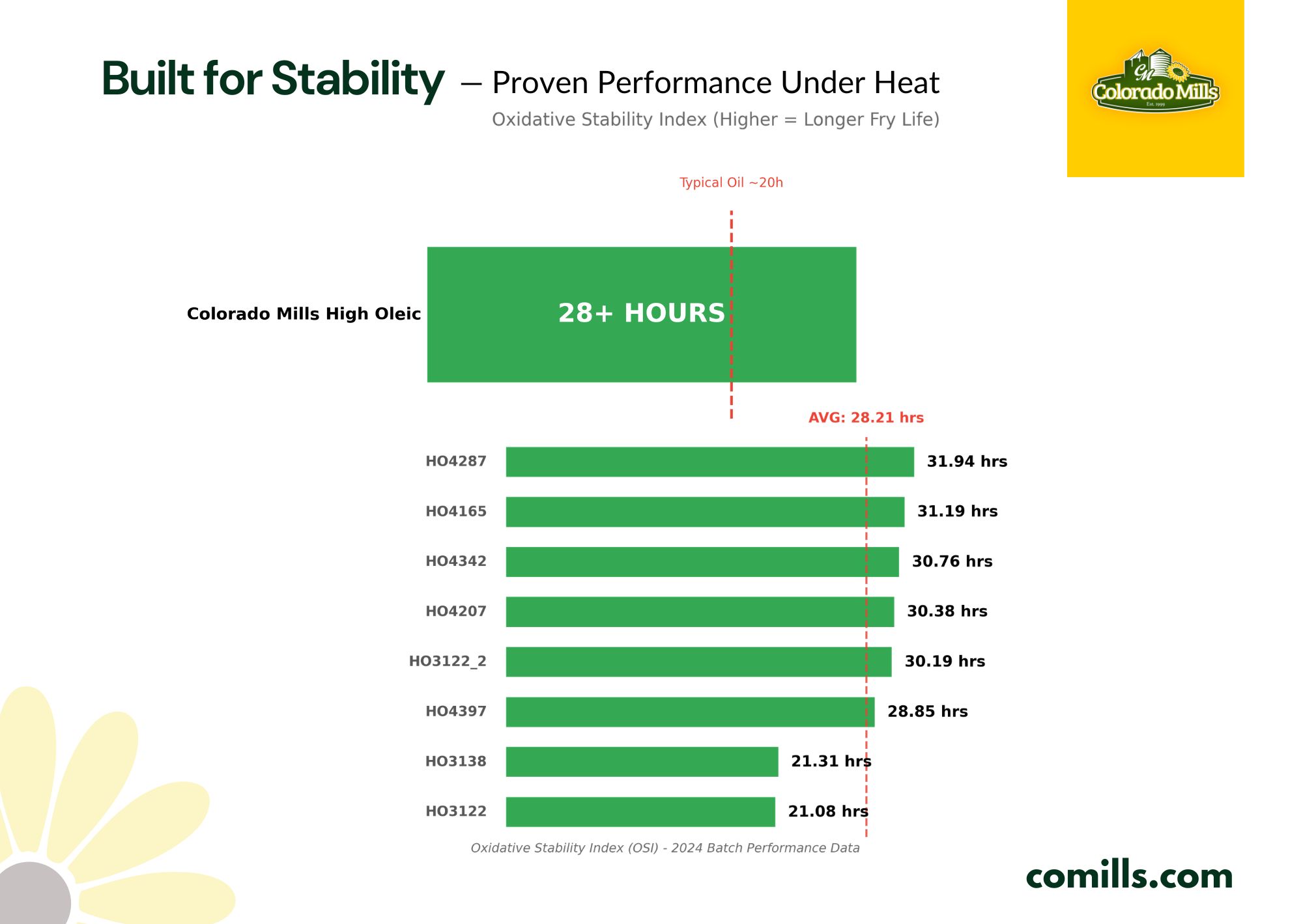
The Fatty Acid Profile is the “Why,” but OSI is the “Proof.” The Oxidative Stability Index (OSI) is a lab test that measures how many hours an oil can resist breaking down.
Because the Colorado Mills profile is so high in stable fats (87% MUFA), it achieves a massive 28.21-hour stability average. A typical oil with a high-PUFA profile might struggle to reach 20 hours.
Guide: This is the final proof. It links the 87% stable profile directly to a verified 28.2-hour durability benchmark.
🔎 Simple Glossary: The Language of Profiles
- Fatty Acid Profile: The “DNA” or makeup of an oil (how much MUFA vs. PUFA).
- High Oleic: An oil profile that is naturally high in stable monounsaturated fats.
- Monounsaturated Fat (MUFA): The “stable” fat that handles heat well.
- Polyunsaturated Fat (PUFA): The “fragile” fat that breaks down and causes off-flavors.
- Oxidation: The process of oil “going bad” due to a weak fatty acid profile.
- OSI (Oxidative Stability Index): The “durability score” that proves how well a profile performs.
Conclusion: Profile is Everything
In the kitchen, an oil’s Fatty Acid Profile is its destiny. By choosing High Oleic Sunflower Oil with an 87% monounsaturated profile, you are choosing an oil built for performance, health, and flavor.
Next time you shop for oil, don’t just look at the name—look at the profile.
Ready to see the difference consistency makes? Contact Colorado Mills today to discuss bulk oil options for your business or find a retailer near you.

0 Comments